Venice Part 3 - The Sideshow

It’s often said that no one in California is from California, and while that may be said about all of the US, it is particularly true of the “Golden State.” It has an allure all its own with the promise of eternal sunshine, and easy living. Its draw bordered on mystical in the 1960s. It was Mecca for the flower children. Many made the pilgrimage.
The Beach Boys sang about California Girls, surfing, and drag racing. The Mommas and Poppas were Californian Dreaming. Scot McKenzie reminded you to “be sure to wear some flowers in your hair.” The birth of the Flower Power Movement was a magnet for every idealistic, disenchanted, lost and lonely teen and young adult, along with petty criminals and psychopaths who sought to cash in on the hippy naiveté.
In the year we spent in Venice Beach, I encountered the proverbial “cross section of humanity,” colorful characters, losers, and seekers, but, also, artists, musicians and sculptors who found a home among the dispossessed.
One afternoon Mary and I were walking along the board walk when a barefoot, bearded, blond-haired man was panhandling. He was older than the usual hippie type and seemed desperate. Since we had no money to give him, we offered to feed him and invited him up to our apartment. We made a pot of rice and beans and he seemed genuinely happy to be fed. When we explained that we were about to meet Bill and Sherry, and that he would have to hit the road, he did so without objection, after thanking us profusely. We spent the rest of the afternoon visiting our friends. About 5:00 we headed back up to our place, only to find that the lock had been smashed, and we had been robbed of what little we had: a clock radio, some clothes and the pot of food.
I don’t recall how I met him, but whenever we had any weed, this impish Mexican I nicknamed “the little fox,” would show up. It was like he had radar. I’d bring home a “lid of grass,” and that evening he’d show up on our porch looking to get stoned. He was short, had characteristic black hair and brown eyes, and seemed to be in continuous motion. He’d pace about, flatter us about our generosity, and try to ingratiate himself by joking and clowning. He was entertaining, and while an opportunist, a decent character. I once asked him what the word was for “fox” in Spanish, and he told me there was none, only “el lobo,” the wolf. He wasn’t a wolf, but certainly a fox, and a bit of a jester.
Every day the boardwalk was filled with people, young and old, many hippies, many straights. That was where I ran into Keith. In his late teens or early twenties, Keith didn’t look the part. His hair was short, he was clean shaven, and looked out of place panhandling in the afternoon sun. Once we started talking he kept going on about how he “wasn’t going to fight for the green-machine anymore.” He was “done with that.” Well, it turns out, not quite done. Keith was AWOL, but had no intentions of returning to duty in the US Army, “…thank you very much.” He spouted anti-war platitudes and slogans, with a bit too much enthusiasm. It was clear that he had joined the Army only to find out it wasn’t what he’d bargained for.
One evening as we were toking up on our porch, the little fox showed up, and this time brought a friend. He introduced his companion as “Hendrix.” Sure enough, this young black man was a dead ringer for the famous musician. I did a double take and asked, “And your name is ‘Hendrix?’” “Yes, brother,” he replied emphatically, “Hendrix!” I had to admit that he did look the part: flowing puffy-sleeved shirt open at the chest, sash around his midriff, bandana tied around his head, bellbottom jeans. He had an affected coolness about him, a relaxed posture. He spoke almost in whispers, punctuating his speech with “Dig it, man,” “That’s cool,” and “Right on!” I never asked if he could actually play guitar.
Weekends the Krishna people descended on the beach. Heads shaved, wearing white robes and garlands, chanting Hare Krishna, and asking for donations. They weren’t nearly as evangelical as Mormons or the Seven Day Adventists, but they were persuasive and committed to their cause. They played hand drums and shook rattles and bells, all the while chanting: Hare Krishna, Hare Krishna, Krishna Krishna, Hare Hare; Hare Rama, Hare Rama, Rama Rama, Hare Hare.
FYI - “Hare Krishna is a mystical sect of Hinduism. It is usually classified as a monotheistic form of Hinduism, since Hare Krishnas believe that all deities are simply various manifestations of the one god, Vishnu or Krishna. The “monotheism” of Hare Krishna is a little muddled, however, as Sri Krishna has an “eternal consort” named Srimati Radharani; together, Krishna and Radharani comprise the “Divine Couple.” https://www.gotquestions.org/Hare-Krishna.html
Lest I forget, the Evangelical Christians were also frequent visitors. Unlike the Krishna people, you couldn’t distinguish them from the rest of the beach crowd. Once they got you in a conversation, you were hard pressed to find an exit. They were “in your face.” I was “accosted” by a pretty young woman who strode up to me, smiled and said, “Jesus loves you.” “Uh-oh,” I thought, “Here it comes.” She pressed me for about 10 minutes insisting that I recognize Jesus as my “lord and savior,” and the “one true way to salvation.” Compared to the Krishna people the Christians had a heavy-handed approach.
That the two, the Krishnas and the Christians, were regulars spoke to that fact that so many of us in Southern California were seekers, lost souls in search of meaning and connection. The climate was ripe for those who were in the “business” of harvesting souls.
Franklin often invited us to parties that he and Barbara threw at their place. The size of the place, small, made the atmosphere feel quite intimate. Their friends consisted of artists, aspiring actors, and others in the film industry.
(Franklin once suggested that I audition for a part in a film about “The Fabulous Furry Freak Brothers” that friends of his were considering making. He thought I was a dead ringer for one of the characters. I declined. The film was ever made.)
 Contributors to Wikimedia projects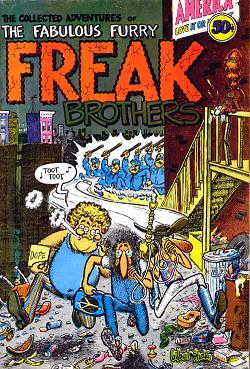
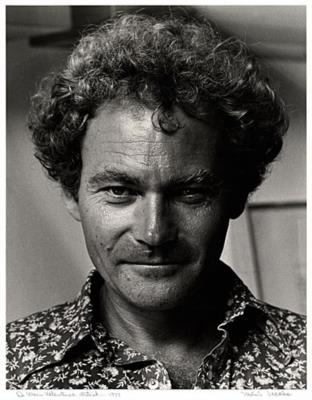
The conversations were stimulating. I was introduced to a sculptor by the name of De Wain Valentine, or simply Wain. He definitely looked the part in a white sheep skin vest, and a head of wild curly hair. When I asked about his work, he told me that he was preparing pieces for a show in Paris. I have to admit that I was quite impressed. He was already an internationally known artist and yet was humble and down to earth.
From time to time I would run into someone I had met at one of the parties. I was always greeted like a friend and we would stop and talk for a few minutes. As I was walking up a side street in Venice, the door of a low warehouse opened and out popped Wain. He recognized me right away and asked if I’d like to see some of his work. Graciously, Wain ushered me into an enormous studio work space and gave me a tour of his work, huge acrylic geometric figures. It was stunning.

Venice, then, was nothing if not a soup bowl of characters from every walk of life from street activists raging against new condo projects and gentrification, to clothing designers, body builders, shop keepers, junkies, down-and-outs, and itinerant hippies. It was, not to put too fine a point on it, a continuous sideshow.